Fast summary
The short answer
A dream sign is a detail you can use as a possible cue to recognise a dream: an unusual event, inconsistency or personally recurring feature. A recurring theme may be worth reviewing, but is not proof of dreaming or a universal symbol. The useful question is “What could I notice?”, not “What must this mean?”

Review
Start with a remembered detail, not a symbol dictionary.

Notice
Choose a cue that matters in your own record.

Rehearse
If you choose MILD, imagine noticing that cue.
What counts as a dream sign?
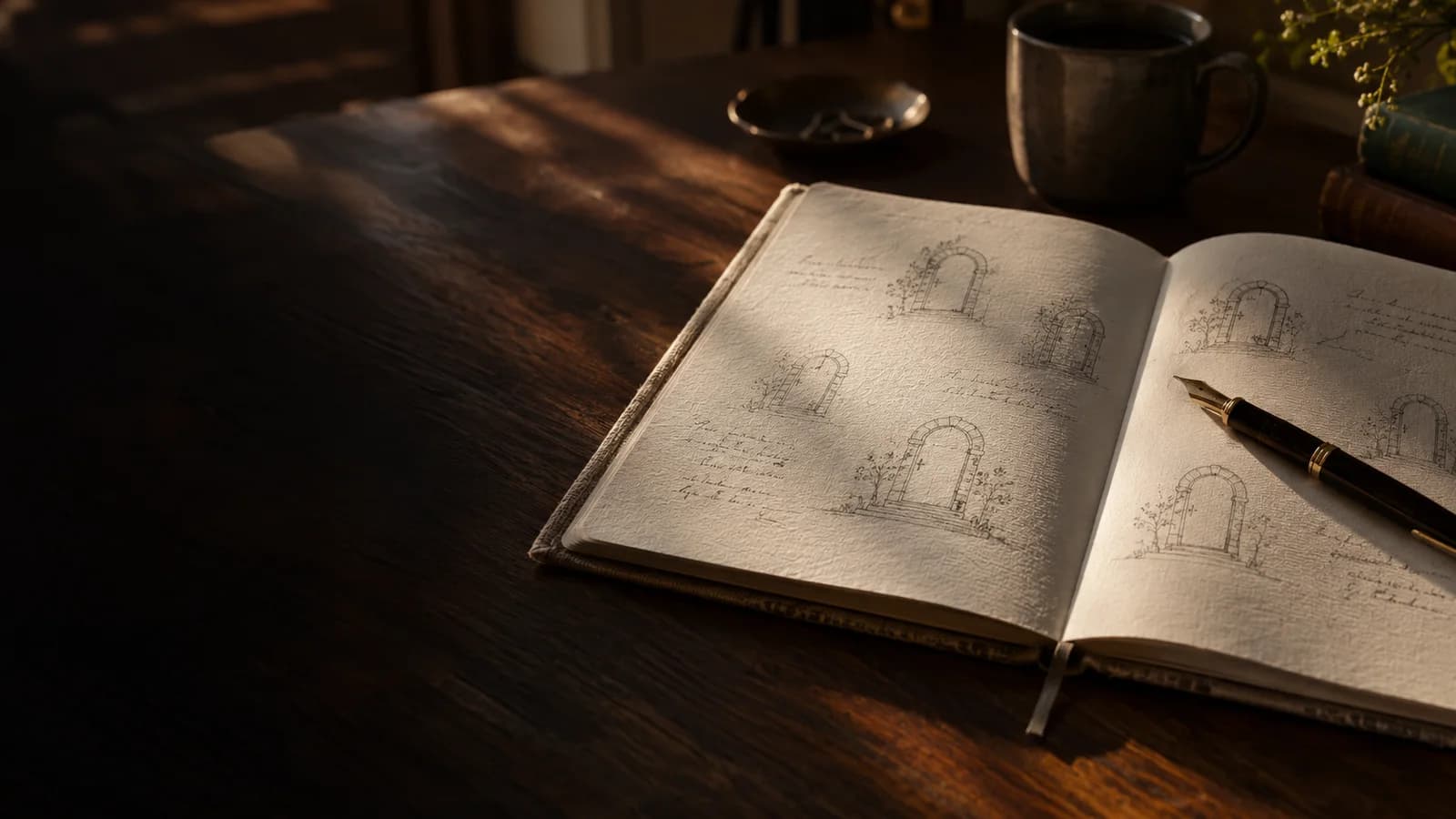
In lucid-dreaming practice, a dream sign is a possible recognition cue within a dream. A door opening into an impossible room is an obvious candidate. A familiar school or a repeated conversation might also be personally noticeable, even if neither is strange by itself.
Erlacher and Stumbrys describe identifying improbable details in dream reports as part of a combined MILD and Wake Back To Bed procedure. That is a practical use of the term, not a test that every odd detail will reliably trigger lucidity.
Sources: Erlacher & Stumbrys (2020) — Wake Up, Work on Dreams, Back to Bed and Lucid Dream
Examples without a universal symbol code
The examples below are invented prompts for reviewing notes. They are not a validated classification and do not assign meanings to objects. A doorway does not carry the same personal significance for every reader; seeing a familiar place does not show that you are dreaming.
Choose precise wording. “The kitchen led into my old classroom” is more useful as a possible cue than “rooms”. “I noticed the wrong season” keeps the remembered mismatch visible without turning it into a prediction.
| Possible cue | Illustrative detail | What not to conclude |
|---|---|---|
| Place or context | An old classroom appears inside a current home. | A school always has one hidden meaning. |
| Action or event | A train changes destination halfway through a sentence. | An odd event guarantees lucidity. |
| Appearance or inconsistency | A familiar door opens into an impossible space. | A single feature proves whether you are awake. |
| Personal recurrence | The same hallway appears in several remembered notes. | The motif predicts the next dream. |
How to find your own possible cues
Our suggested review is deliberately small. Use a few entries you already have, at a time when you are awake and comfortable. Keep the original wording visible so that a later label does not silently change what you remembered.
Mark one detail that was unusual in the scene or that appears in more than one actual note. A single memorable mismatch can be a rehearsal cue; it does not have to recur. If nothing stands out, leave the field blank rather than inventing a pattern.
- Quote the relevant detail before adding a label.
- Distinguish one occurrence from a feature you found in several entries.
- Do not treat missing entries as nights when the feature was absent.
- Keep labels revisable; a note is not a diagnosis.
- 01
Read
Return to an actual note and keep uncertain details uncertain.
- 02
Mark
Underline one remembered mismatch or recurring feature.
- 03

Name
Give it a short descriptive label in your own words.
How a dream sign fits into MILD
MILD uses a remembered dream, mental rehearsal and an intention to recognise a future dream. In the International Lucid Dream Induction Study, participants imagined returning to a remembered scene and noticing something unusual. The cue gives the rehearsal a specific moment rather than turning the exercise into a repeated wish.
For example, imagine the classroom appearing behind the kitchen door and rehearse noticing that mismatch as a dream cue. This invented rehearsal illustrates the link; it is not a promise that the scene will return or that recognition will happen tonight. The MILD guide contains the wider procedure and its sleep-related limits.
Read the full MILD guideCompare reality checksA small example and reusable worksheet
This invented example separates the source detail, the later label and a possible intention. The label is an addition to the record, not a replacement for it. You can use the same format on paper without any application.
If you later realise you filled in a detail you do not actually remember, revise the label or remove it. You do not need to keep a large catalogue of signs. One clearly described cue is easier to review than a long list of guessed interpretations.
Illustrative cue review
- Source detail
- “I opened the kitchen door and saw my old classroom.”
- Short label
- A familiar door leading somewhere unexpected.
- Recurrence
- One clear example so far; no repeated pattern claimed.
- Optional rehearsal
- Imagine noticing the mismatched room and recognising the scene as a dream.

This is an invented teaching example, not a personal reading or a research result.
Entry date or reference:
Exact remembered detail:
What seemed unusual or repeated:
Possible cue label:
One occurrence / seen in these other notes:
What remains uncertain:
Optional MILD rehearsal:
My later reflection (separate from the memory):
Dream sign, theme and interpretation are different
A theme groups notes, such as journeys or unfamiliar homes. A dream sign is a possible recognition cue, such as the destination changing unexpectedly. An interpretation is a thought you have about what an experience might mean. Keeping these separate makes later reflection more honest.
A frightening scene does not predict an event. A recurring person does not tell you what that person thinks. You may find personal associations useful, but you do not have to attach a meaning to every detail. Leaving a question open is different from overlooking it.
Record before interpretingCompare common termsMap recurring dream locationsSeparate signs from emotional meaningWhat the evidence does—and does not—support
The laboratory paper studied a combined procedure with dream reporting, finding signs, MILD and scheduled waking. It did not isolate the benefit of collecting dream signs. The larger field study also used combined methods and self-reported outcomes over a short period. Neither validates a universal list of symbols or guarantees a particular reader’s success.
Your own notes have limits too: you remember some dreams and not others, use changing labels and may notice a feature more after choosing it as a cue. A count describes what is in the available records, not all your dreams or what caused them.
Put sleep quality firstRead research in contextSources: Erlacher & Stumbrys (2020) — Wake Up, Work on Dreams, Back to Bed and Lucid Dream; International Lucid Dream Induction Study (2020)
Frequently asked questions
Does a dream sign have to recur?
No. One memorable inconsistency can be a possible rehearsal cue. A recurring feature is another option, but recurrence alone does not prove that a scene is a dream.
What if I cannot find any dream signs?
Keep a plain record and leave the cue field blank. You do not need to invent an unusual detail or turn every entry into a lucid-dreaming exercise.
Are dream signs the same as dream symbols?
Not in this guide. A dream sign is a possible recognition cue. A symbol interpretation is an idea about meaning, and there is no universal meaning assigned to the examples here.
Can I use an ordinary place as a dream sign?
It can be a personal review cue if it stands out in your notes. The ordinary place by itself is not proof of dreaming; a specific mismatch or context may be more useful to describe.
Will keeping a list make me lucid?
There is no guarantee. Studies of combined induction methods do not establish that maintaining a list alone produces lucid dreams. You can use it for reflection without practising induction.
Do I need reality checks whenever I see the cue?
No. This review does not prescribe repeated daytime testing. Reality checks are a separate practice, and they should never involve risk, pain or restricted breathing.
Sources and further reading
- Erlacher & Stumbrys (2020) — Wake Up, Work on Dreams, Back to Bed and Lucid DreamFull open-access methods and results checked. Finding dream signs was part of a small combined WBTB/MILD procedure, not isolated as an independent treatment.
- International Lucid Dream Induction Study (2020)Full open-access paper checked. Selected interested participants, short duration and self-report limit generalisation; cue rehearsal is part of the method.